

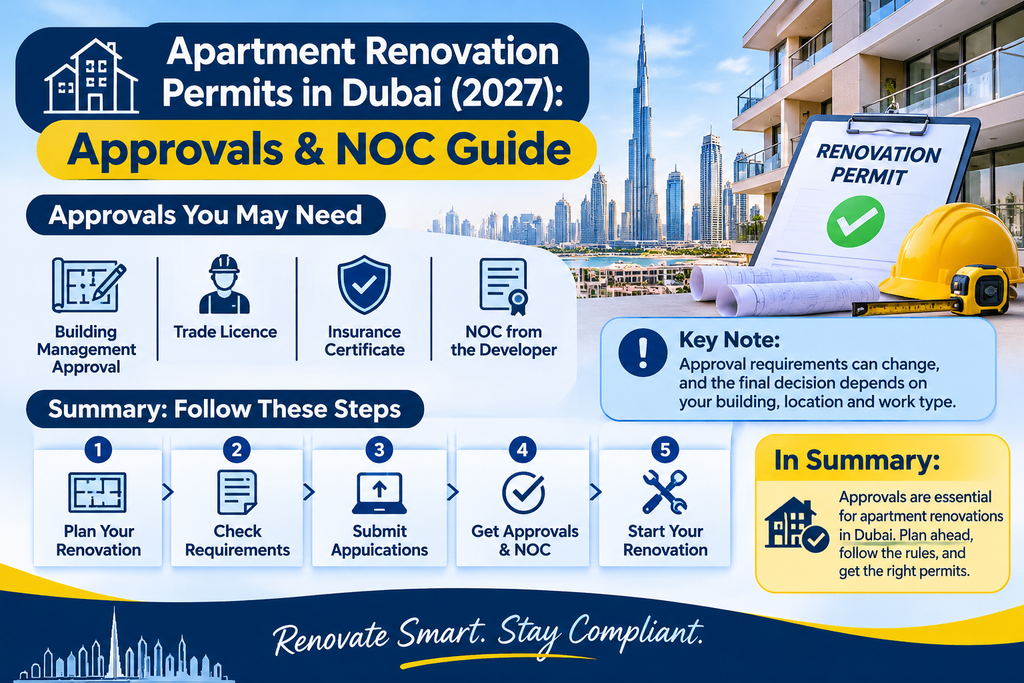
Once decisions have been made on your new design, tiling options and selected contractor, you may be asked by the building management to provide plans, a trade licence and an insurance certificate. Often, at this stage, owners realise that an apartment renovation Dubai project requires a range of approvals before work can begin.
The reason approvals are required in flats is due to shared infrastructure within the building. Pipes may run into main risers. Fire detection equipment and sprinklers may be installed in false ceilings, protecting the building as a whole. This article aims to explain which approvals are required, what types of work require approvals, and the process of getting them. It will also help you avoid costly mistakes in your project in towers across Dubai Marina and Business Bay.
Note: Approval requirements depend on the building, location, type of work and governing body of the area. These requirements can change, and information on official requirements for 2027 may not be available yet. This article provides general guidance. To ensure you know the current requirements, please contact building management and the correct governing body.
Summary:
In most cases, approval from building management/owners association will be required to complete any renovations within an apartment in Dubai (often referred to as a Renovation NOC). If you are completing minor decoration only, this may be the only approval needed. If partitions, ceilings, MEP, fire installations or structural changes are being carried out, a permit from a government authority will likely be required. Depending on where in the building you are, Dubai Municipality, Dubai Development Authority (DDA) or Trakhees may be the correct authority to contact. In some communities, a master developer NOC will be required. What approvals are required will depend on which building you are in and what work you are completing.
Do You Need Permission to Renovate an Apartment in Dubai?
In most cases, yes, at least from your building. Even when no government permit is required, almost every building has renovation guidelines that cover working hours, contractor access, waste disposal and deposits. Starting without building management approval is one of the quickest ways to have work stopped.
The key point is that there are two separate tracks:
- Building-level approval: permission from the people who manage your building or community.
- Authority-level approval: a government permit confirming the work meets building, structural and fire-safety rules.
A building NOC is not a government permit, and a government permit doesn’t replace the building’s own approval. Many projects need both.
Who Approves What: The Main Approvals Explained
Building management approval
Building management approval in Dubai comes from the facilities management company or the owners’ association (OA) that runs your tower. It confirms that the building agrees to the work and sets the conditions: approved contractor, working hours, lift use, deposits and handover checks. In many towers in JLT, JVC, Dubai Marina and Downtown Dubai, this is the first form you’ll fill in.
No Objection Certificate (NOC)
An NOC is a written statement that a party has no objection to your work. In apartment renovation, the term is used for several documents: the building’s renovation NOC, the master developer’s NOC and, for some works, NOCs from bodies such as Dubai Civil Defence or DEWA. Always ask exactly which NOC is required and who issues it.
Master developer approval
In master-planned communities, the master developer or its community management may need to approve works, especially anything external, structural or affecting shared services. Emaar, for example, publishes a home modifications process for its communities and notes that works must also follow Dubai Municipality, DDA and Dubai Civil Defence guidelines where applicable.
Dubai Municipality approval
Dubai Municipality (DM) is the main building authority for much of mainland Dubai. Its building permit system covers modifications to existing buildings. In 2023, DM publicly reminded residents that a permit was needed in units over 100 m² for works such as suspended ceilings, flooring, shelves and internal partitions, and described unauthorised changes as violations. Services have been restructured since, so check the current requirement through Dubai Municipality’s official services.
Dubai Development Authority (DDA) approval
The DDA regulates building works in its own jurisdiction, which covers a number of development districts and free zone communities. Its Permits and NOCs services include a Fit-Out Permit, applied for by the contractor. DDA’s published guidance also says that adding structural elements, changing the use or adding floor area goes through a separate Building Modification process. A DDA circular lists some minor works within a unit, such as internal painting, that can go ahead on a landlord or facilities management NOC instead of a DDA fit-out permit, but anything outside that list needs the permit. Confirm the current list with DDA before relying on it.
Trakhees approval
Trakhees, part of the Ports, Customs and Free Zone Corporation (PCFC), is the building authority in certain areas of Dubai, including some island and free zone communities. Its published circulars set out which minor decoration works are exempt and which modifications need a Modification NOC.
Which authority covers your apartment?
The responsible authority depends on your building’s location and jurisdiction, not on the type of work. Two apartments in different communities can follow completely different approval routes for the same kitchen renovation. An owner on Palm Jumeirah, one in Dubai Hills Estate and one in Al Barsha may each deal with a different mix of building management, master developer and government authority. Your building management can usually tell you which authority applies, and a qualified contractor or consultant should confirm it before preparing drawings.
Which Apartment Renovation Works May Need Approval?
The table shows what is commonly involved. It is a general guide only, because requirements vary by building and authority.
| Type of work | Building approval | Authority permit may be needed when… |
| Kitchen renovation | Usually | plumbing, drainage, electrical circuits or exhaust are changed |
| Bathroom renovation | Usually | drainage, waterproofing or wet-area layout is changed |
| Flooring replacement | Usually | the floor build-up, loads or acoustic layer change, or local rules require it |
| Wall removal and partitions | Yes | almost always for new or removed partitions; structural walls need engineering approval |
| False ceiling installation | Usually | new ceilings affect fire alarms, sprinklers or access to services |
| Electrical modifications | Yes | new circuits, load changes or distribution board changes are involved |
| Plumbing modifications | Yes | supply or drainage is relocated or connected to shared risers |
| AC and ventilation changes | Yes | units, ducts, diffusers or exhaust connections are changed |
| Lighting installation | Often | new circuits or ceiling cut-outs are needed |
| Painting and decorative work | Often a simple notification | rarely, though building rules still apply |
| Structural modifications | Yes | always, with structural engineering input |
| Balcony and external changes | Yes | almost always; external changes are usually tightly controlled |
Kitchen/Bathroom
Due to water, drainage and electrical components, changes to kitchens/bathrooms are rarely superficial. Simply replacing cabinetry in the same location is generally less complex. Adding plumbing to accommodate for an island, or moving showers can be more complex. As there may be water proofing requirements in wet areas, consideration of how this is going to be achieved is often requested by buildings.
Walls/Partitions/ceilings
If partitions are removed/add to the building, this can alter the layout, possibly affecting safe egress and fire detection in the building. Often fire detection alarms and sprinkler heads are installed within false ceilings. If these are moved or covered without approval, this can pose serious safety risks within the building.
Electrical, plumbing and AC work
Any MEP works can effect common areas within the building. Increasing the electrical demand, changing drainage stacks or altering air conditioning can effect neighbouring areas and equipment. Due to this, drawings and a qualified contractor is generally required.
Balconies/External changes
Changes to balconies (to enclose), balustrading or any external changes that can be seen from outside the building, will generally require approval from the building and developer. Often permission from the authority is required also. In many buildings, these changes are not permitted.
Minor Cosmetic Works: Simpler, but Still Check
Works like repainting walls, changing light fittings like-for-like, replacing furniture or updating handles and taps often have the simplest requirements. Published DDA guidance, for example, lists internal painting among the works that can proceed on a landlord or facilities management NOC without a DDA fit-out permit.
That doesn’t mean you can just start. Most buildings still want to know who is working in the apartment, when, and how materials and waste will be moved. A quick email to building management before painting or minor works avoids security problems at the gate and complaints from neighbours.
The Apartment Renovation Approval Process, Step by Step
- Identify the responsible authority and management. Find out who manages your building and which authority covers your area. Building management is usually the fastest source.
- Read the renovation guidelines. Ask for the building’s fit-out or renovation guidelines, including permitted working hours, noise rules, deposit amounts and contractor requirements.
- Appoint the right contractor or consultant. For anything beyond cosmetic work, choose an appropriately licensed contractor, and a consultant where the authority requires one.
- Prepare drawings and documents. Existing and proposed layouts, MEP drawings where needed, the scope of work and material specifications.
- Apply for the building or community NOC. Submit the application with the documents the building asks for, and pay any deposit.
- Obtain authority permits where required. Your contractor or consultant submits to Dubai Municipality, DDA, Trakhees or other bodies, depending on jurisdiction and scope.
- Arrange access and work permits. Register workers, book lift use and agree delivery and waste routes with the building.
- Carry out the work as approved. Stick to the approved drawings. Any change on site may need a revised approval.
- Complete inspections and close-out. Arrange any authority inspections or completion approvals, then the building’s final inspection, so your deposit can be released.
Documents Commonly Requested
Requirements vary, but buildings and authorities commonly ask for:
- title deed or proof of ownership
- owner’s Emirates ID or passport
- the building management application form
- contractor’s trade licence
- contractor’s insurance, often third-party liability and workers’ cover
- existing and proposed floor plans
- electrical and plumbing drawings, where MEP is changing
- a written scope of work
- material specifications, sometimes with fire ratings
- relevant authority approvals or permits
Tenants usually need the landlord’s written consent as well, as most buildings accept applications only through or with the owner.
Why the Right Contractor Matters
Who does the work affects both the approval and the result. A suitably licensed and registered contractor can submit to the relevant authority, carries insurance the building will accept, and knows how to work within tower rules. Unlicensed or informal labour may be cheaper, but buildings often refuse access, and authorities may not accept their submissions. If something goes wrong, such as a leak into the flat below, insurance and accountability matter.
When comparing apartment renovation contractors in Dubai, ask:
- Is your trade licence valid for this type of work?
- Can you submit to the authority that covers my building?
- What insurance do you hold?
- Have you worked under this building’s or developer’s rules before?
- Who prepares the drawings and handles the NOC?
Building Rules You’ll Need to Follow
Every building sets its own rules, but common ones include:
- Working hours. Noisy work is often limited to weekday daytime hours, with restrictions on weekends and public holidays.
- Noise. Drilling, breaking and cutting may be limited to set windows.
- Waste disposal. Debris usually has to be bagged and removed by the contractor, not left in the building’s bins.
- Lift protection. Lifts and corridors usually must be protected, and service lifts booked in advance.
- Contractor access. Workers are typically registered with security and may need ID cards.
- Safety. Fire alarms and sprinklers must not be disabled or covered without permission, and hot works often need a separate permit.
Breaking these rules can lead to fines from the building or deductions from your deposit.
What Happens If You Renovate Without Approval?
Starting without the right approvals can lead to:
- Work stoppages by building management or authority inspectors
- Penalties, which Dubai Municipality has said apply to unauthorised changes and partitions
- Corrective work, including undoing what was built and restoring the original layout
- Lost deposits held by building management
- Disputes with neighbours, the owners’ association or future buyers
- Problems when selling or leasing, if unapproved changes are found later
The DDA also publishes guidance on construction without permits or approvals, which is worth reading if you’re in its jurisdiction.
How Long Do Approvals Take?
There is no single answer. Approval time depends on the building, the authority, the scope and the quality of the submission. A painting notice may be handled quickly. A kitchen with new plumbing, a new partition or MEP changes can take noticeably longer, especially if an authority permit is needed.
Common causes of delay include:
- incomplete applications or missing documents
- drawings that don’t match the building’s requirements
- comments from the authority that need resubmission
- waiting for master developer or owners’ association responses
- design changes after approval
Build approval time into your plan rather than booking trades for day one.
Common Mistakes, and How to Avoid Them
- Assuming the contractor has handled it. Ask to see the NOC and any permits before work starts.
- Treating the building NOC as a government permit. Check whether an authority permit is also needed.
- Changing the design on site. Changes may need fresh approval.
- Ignoring fire systems. Moving detectors or sprinklers without approval is a safety risk.
- Forgetting the close-out. Without final inspections, deposits can be held and future sales delayed.
- Relying on old information. Rules change. Confirm the current requirements every time.
How Designers and Contractors Help
A professional team can coordinate the drawings, documents and submissions, so the design that gets approved is the design that gets built. That means fewer surprises, fewer resubmissions and a smoother handover.
DA Interior Design & Decor provides residential interior design in Dubai and professional apartment fit-out services, helping owners plan layouts, prepare the information buildings typically ask for and coordinate apartment renovation from design to handover. You can see examples of our apartment renovation and interior design projects and learn more about our team.
Frequently Asked Questions
Do I need a permit to renovate my apartment in Dubai?
You’ll almost always need building management approval. A government permit may also be needed, depending on your building’s location, the authority that covers it and the scope of work. Cosmetic work usually has the simplest requirements.
What’s the difference between a building NOC and a government permit?
A building NOC is permission from your building’s management or owners’ association. A government permit comes from an authority such as Dubai Municipality, DDA or Trakhees and confirms the work meets building and safety rules. Many projects need both.
Do I need approval to paint my apartment?
Painting usually has the simplest requirements, but most buildings still want to be informed and to register your painters. Check your building’s guidelines first.
Do I need a permit to remove a wall in my apartment?
Almost certainly. Removing or adding partitions changes the approved layout and can affect fire safety. Structural walls need engineering input and authority approval, and some buildings won’t allow it at all.
Can a tenant renovate an apartment in Dubai?
Only with the landlord’s written consent, and usually through the landlord’s application to building management.
Who applies for the permit, me or the contractor?
It depends. Building NOCs are often applied for by or with the owner. Authority permits are commonly submitted by the contractor or consultant. DDA, for example, lists the contractor as the requester for its Fit-Out Permit.
How long does apartment renovation approval take in Dubai?
It varies by building, authority and scope. Complete applications move faster. Allow time in your plan and avoid fixing start dates until approvals are confirmed.
What happens if I renovate without approval?
You risk work being stopped, penalties, being asked to undo the work, losing your deposit and problems when you sell or lease.
Does approval affect apartment renovation cost in Dubai?
Yes, to a degree. Drawings, consultant input, authority fees and deposits add to the budget, and delays can add to labour costs. Ask for these items to be shown separately in your quotation.
Conclusion:
Apartment renovation in Dubai goes smoothly when approvals are planned as carefully as the design. Start by finding out who manages your building and which authority covers it, read the renovation guidelines, and confirm what your scope needs before booking any trades. Keep building approvals and government permits separate in your mind, build in time for reviews, and work only to approved drawings.
Book an Apartment Renovation Consultation
Planning an apartment refurbishment or a full apartment interior renovation in Dubai? Book an apartment renovation consultation with DA Interior Design & Decor. We’ll review your plans, discuss the approvals your scope is likely to need, and help you move from design to handover. Explore our apartment renovation services in Dubai to see how we work.




Leave a Reply